
Kazmo Studios Interview
By Wazza

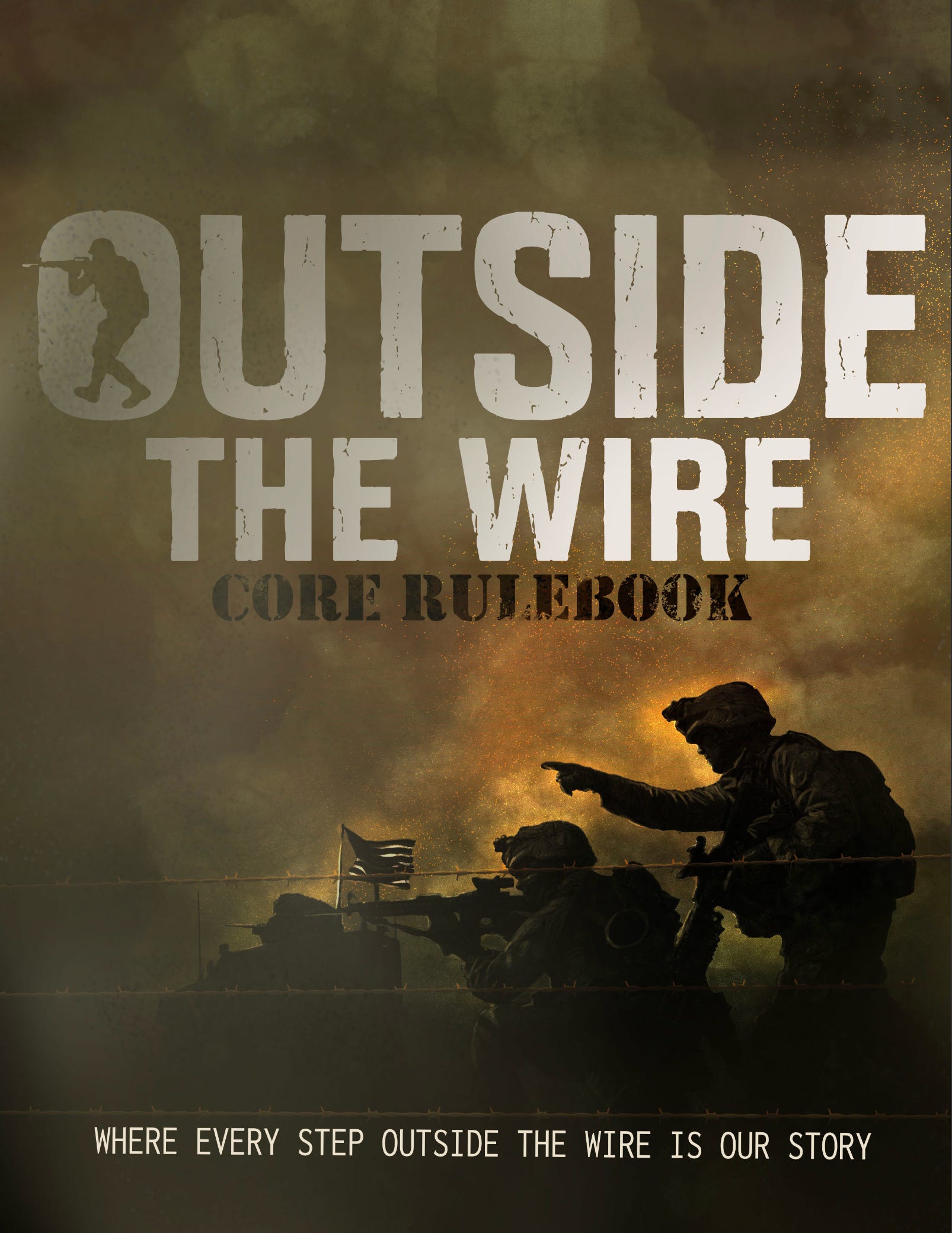
Derek Roberson of Kazmo Studios was kind enough to answer my questions concerning their upcoming Tactical TTRPG: Outside The Wire, as well as his thoughts on roleplaying in general.
Q1: How would you promote Outside The Wire, and what unique qualities does it possess?
Outside the Wire is a modern war sandbox RPG about dismantling hostile networks in a volatile region while also building legitimacy. The game strives to link sessions in an ecosystem that reshapes the human terrain based on player decisions or actions.
The game allows players to build characters from 13 nations, across a dozen specialties. We leaned heavily into building a game where each specialty can be played successfully in each scenario. Non-kinetic, non-violent actions can have a greater positive impact than violence. The combat is deadly; enter at your own peril.
Q2: Is this your first published game?
Yes. While I have played for forty years, this endeavor was born from many sessions.
Q3: How did you know what to build and focus on when designing Outside The Wire?
I simply added components that I enjoyed over the years and wanted to play. This creative adventure started very much as an RPG based on my 80s love of TW2000 (core book at ~85 pages), very much a tactical TTRPG.
Then I started to pull in pieces that allowed Campaign/ Sandbox play, and to this day still mentally (theater of mind) play from MERC, Recon, and Traveler (core book now about 150 pages). I still have a Recon campaign going in “Sangria”, a fictitious region. We added the ability to build fictional sandboxes or give structure to historical conflicts.
Then I plugged in a Solo play option (Core book ~200 pages) as that is what most of my play has been. Next, I started building a few scenarios to test the system. These led to the idea of linking the sessions to build an ecosystem that responds to the players’ actions. I found a few playtesters during this process, who provided great discussions, stimulated ideas, and helped me focus.
Throughout the creation process, this close-knit group shared experiences and gaming nuances that added uncanny human realism. While very much a wargame, we recognized that there are both kinetic (raids, ambushes) and non-kinetic “adventures” that happen downrange - way outside of a combat patrol - that would make a great scenario and be group RPG-able. In many ways, the ability to go from a “Tattooine” bar-like scene negotiating a merc contract to combat is part of what made my experiences with TW2000 and Traveller, to name a few, fun. In this space, we hope players will also find Outside the Wire.
Q4: How did you come up with the game system?
The system changed drastically throughout the building process, driven entirely by playtesting. Initially, I had many of the standard characteristics of a skirmish game, where the GM/Players have multiple dice modifiers to determine what happens. As we added player skill levels and leveling up, the system failed, so we tried different dice types (3d6, 2d10, 2d10 + 1d6). We fell on 2d10, heavily on theater of mind, and solo play rules. The system is designed to reflect incremental gains in skill and knowledge through combat deployments, giving players a better chance of success and reducing randomness as they advance in rank.
A moment on solo play design. After adapting a basic oracle (yes, no, but), we added enemy automata (charts to determine actions) and a sunlight dial. The sunlight dial is a means to drive the play forward: the dial advances after each player action, and if it reaches 10, the players fail the mission. Do I talk with a neighbor or the children playing in the courtyard? Do we have time to recon the target? The idea is that the players can not do everything, but must make cost-benefit decisions. The GM-led groups have also enjoyed this.
The Sandbox Ecosystem was another interesting development, both in terms of gaming and tactics. How do we measure changes in the environment as the characters advance? The first tools included Intelligence, criminal activity, insurgent activity, local civilian trust, Government trust, and command support. This was too much to track at a gaming table. We fell on Command confidence (are you doing what they want, how they want), Local Trusts (how much the populace support you/ trust you), and Insurgent Activity. This is very much a Clausewitzian trinity - where one action doesn’t support all three areas.
Finally, the campaign design has been one of my favorite areas. Essentially bolted onto the sandbox ecosystem, we designed a “deployment” system where players deploy to a region for a set period to stabilize the area. The system has a weekly battle rhythm that includes intelligence collection, factional politics, tactical operations, logistics, the creation of local forces, bribes, and even civil affairs projects. If command confidence falls to 0, the players are relieved (fired). A win is creating a local force to replace you and continue stabilizing the region. Of course, if local trust is low, you can’t recruit locals. High Insurgent Activity negates local force gains. Back to the Clausewitzian trinity.
Q5: Do you have any advice for new GMs and Players who want to try Outside The Wire?
While the character generation system allows multiple “enlistments” to gain experience, I recommend only one enlistment: get the promotion to Sergeant, then start play by leading a squad of “NPCs”. For group play, also bring the squad - while this might seem like overkill in firepower (a squad tagging along), focus on keeping them all alive and accomplishing the mission.
Q6: When will Outside The Wire be released?
We plan to launch our Kickstarter on 1 Sept 2026. The first 48 hours will be discounted tiers. The initial release will include the core game book, a starter box (Ambush at Dawn scenario), and a deluxe box (Core book, Iron Crossing Campaign, and Tactical Immersion kit).
Q7: Can you tell us about future releases?
Oh, absolutely. Through playtesting, we have developed several scenarios tied to the initial Iron Crossing Campaign and a separate Africa Campaign (in which players serve in the French Foreign Legion on a mission to take down child kidnappers). Some of the scenarios will likely be stretch goals for the KS campaign. My vision has four regional sourcebooks with campaigns (Americas, Africa, the Philippines, and the Middle East).
Q8: Will there be VTT support for Outside The Wire?
I am currently working on a Foundry VTT solution - this effort came about from talking with veteran-focused gaming groups, such as Steve Bomford at Company of Makers, who helped me realize that most veterans TTRPG online. There is also a group working on a TTS (Steam) VTT - this is a grassroots effort that I fully endorse.
Q9: Do you have a Discord Channel?
No. Admittedly, a good idea. But Kazmo Studios is really one person, and I am a bit tapped at the moment. We currently have a Reddit, Instagram, and Facebook.
Q10: What would you consider the special moments in your creative career?
Definitely speaking to so many fellow gamers and creators as they join me on this side quest to bring this game to life. Heck, almost everyone that I have worked with - all the developers, game company managers, graphic designers, marketers (Crowdfunding Nerds), Nigel at Games Quest, Katie at QML, the list goes on- are immediately curious, not judgmental, quick to help, offer support, and genuinely enjoy hearing about new creations. These moments, while brief, certainly have inspired me.
Q11: What’s your favourite aspect of role-playing, and what category of gamer do you associate with?
Gosh, really enjoy creating characters and fictional worlds, and often building challenges around them that evolve with the characters.
Q12: How long was the play-testing period for Outside The Wire?
Testing started in earnest last July (2025), and has been ongoing since. I recently brought in three more groups to play and get a fresh perspective. Testing has really helped us see the best parts (what people enjoy) and the parts that need work.
While I initially paid for the playtesting, it has recently become all-volunteer as the game has attracted more attention. The overall group has brought in a range of experience, humor, and thinking. The key play testers (some play solo and others GM) include a family-man baker in Minnesota, a Kiwi Psychologist, a Brazilian professor, a Norwegian College student, a writer (82d AFG vet), a French businessman, two current Army soldiers, a newspaper editor (and Marine), and a Ukrainian Freedom Fighter. I would love to get them all in the same room.
Q13: What’s your favourite die and why?
I know I dislike 1d4… and like 1D20 the most because of its total randomness.
Q14: What’s your first ever RPG session and did you catch the gaming bug straightaway?
It was a Traveller session, where I made my first character “Kazmo”, a scientist, and yes, I absolutely caught the bug.
Q15: Whom do you admire the most in the RPG community and why?
Since the 80s, I have followed and bought anything GDW, with my most admired being Mark Miller. He gave me the bug, the creative imagination for RPGs.
Q16: What do you like when you’re reading TTRPG content?
The sparks of creativity. It can be a cool NPC, a fascinating location, a dilemma that must be solved, a world of fiction that sucks you in.
Q17: What are your thoughts on A.I.?
To be fair, AI is very new to me. I have felt the lure to use it, but luckily I have been wisely counseled to avoid it.
Q18: Would you like to create a TTRPG based on a franchise, and if so, which one would you choose?
Part of me says Red Rising, while another focuses on a Lioness / Sicario setting. So many options.
Thank you for your time!
Thx, review on its way!
My comment on question 8: I (one of the graphic designers on the team, the one who laid out the core book and made the maps) am talking to Roll20 to hopefully get it on that VTT as well! Foundry is guaranteed by the Kickstarter, but I will do my best to have the Roll20 compendium complete for it as well. It's my VTT of choice, but as Derek mentions, he's juggling a lot of roles right now so I'm the one making Roll20 happen. New news, though, as we only started working that out yesterday!
My comment on 17: We talked about whether to use AI or not when I started the project, and decided against it. I prefer that we've decided to honor the actual people who've served in the military by using their public domain photos and crediting them. A ton of human work has gone into making this book happen! As for my part, we mostly used InDesign for the layout. The satellite terrain style maps are a mixture of Gaea for the topography / contours and vector artwork for the overlays, and the closer up fort maps are hand drawn in Clip Studio Paint (I think Derek posted some of my timelapses). Most of the book's artwork is photography from the US Department of Defense with filters and fx. We've done our best to make sure all stock and photo sources are credited out of respect for all of the great human creators who had even a small hand in making the book happen!
I'll see about getting us a Discord set up.