
Gritsilk Games Interview
True Grit

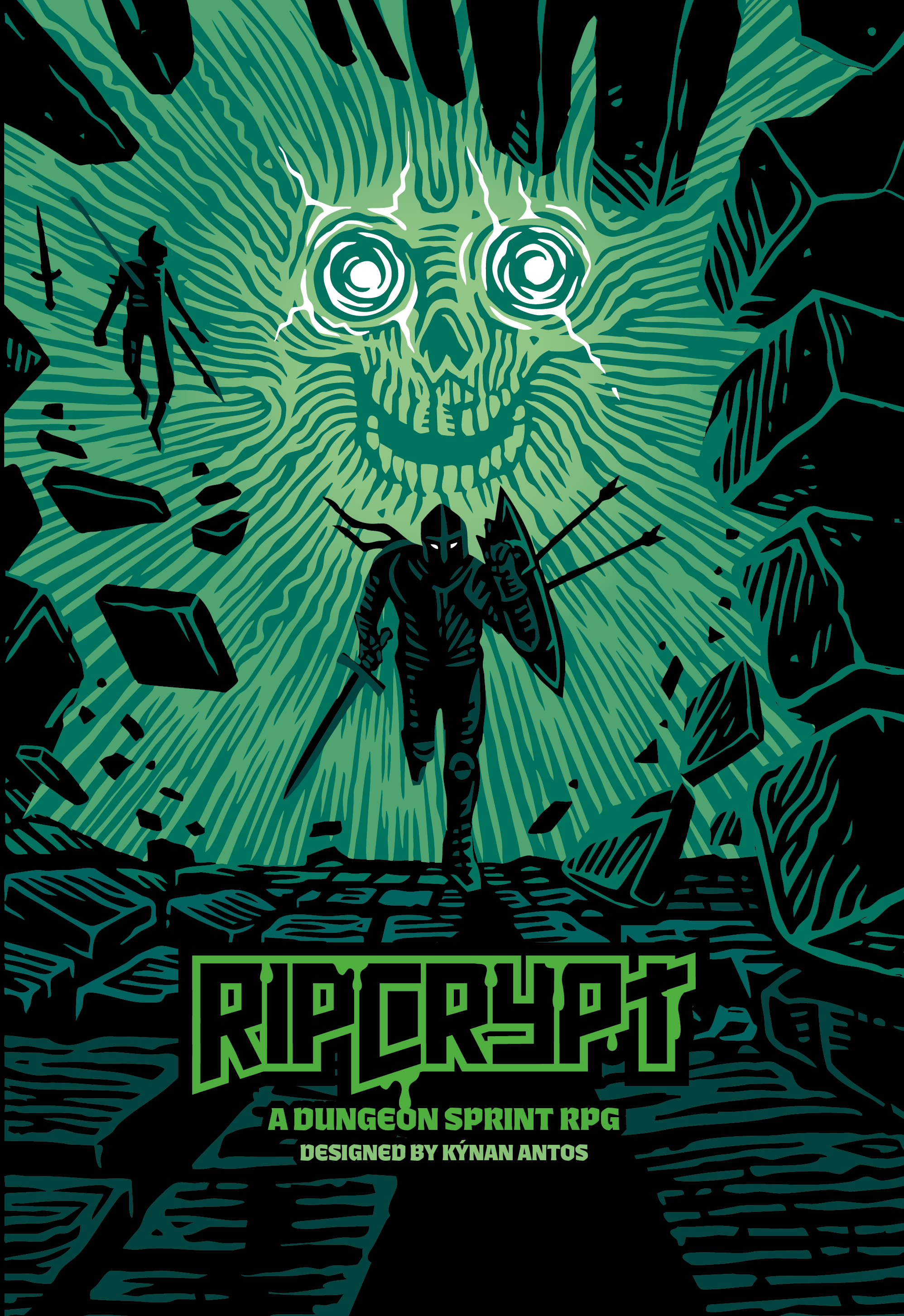
Q1: Describe your relationship with Modiphius, how did you get on board with them?
A1: Chris Birch, co-founder of Modiphius Entertainment reached out early on in the Kickstarter as a fan of solo and cooperative roleplaying games and saw RipCrypt’s ability to realize its full potential through their ViaModiphius program. Chris and I connected as the Kickstarter was coming to a close. He connected me with 4VGames to get production going and really helped me navigate some of the early ambiguity and complexity with the new general product safety regulations (GPSR) that were emerging in the EU at that time. RipCrypt has come a long way in a short time and the support of Chris and Modiphius has just been absolutely incredible. I cannot express my gratitude enough for all of their help and guidance with the games production.
Q2: How would you promote RipCrypt and what’s unique about it?
A2: More sprint. Less crawl. Is the game’s tagline for a reason. RipCrypt is an easy to learn, fast to play, rules-lite dungeon sprint tabletop roleplaying game—that you actually have time to play. It’s designed from the ground up to expedite hero creation for new players, minimize prep for GMs, and uses streamlined mechanics that can be played from memory after a few sessions. Once you get a feel for the system the mechanics disappear and you can really focus on actual roleplaying. What sets it apart is that it is truly faster in every way a roleplaying game can be. You can make heroes, prep a session, and play through an entire 5 room dungeon, end-to-end, in a single 90 minute session. One of the greatest challenges that many groups suffer from is time commitment and scheduling. Just getting folks together to commit for a more traditional 4-6 hour session is next to impossible for many folks these days. Which is why so many RPGs sit on the shelf of shame collecting dust. I wanted a modern game that is cool, dark, and fast, so that you actually have time to play it!
Q3: What’s your favourite aspect of role-playing and what category of gamer do you best associate with?
A3: I do truly love a good dungeon crawl. There’s something magic to me about the progressive reveal of the environment as you descend that I just can’t get enough of—the intrigue and mystery of it all. I grew up with first and second edition D&D and Warhammer Fantasy Roleplay first edition. I’ll never forget being immediately drawn to the darker tone, mood, artwork, and gritty realism of WHFRP way back in the mid 80s. I also really appreciated how deadly the game was as a player. There were real consequences. The right answer in most cases starting out, was to run away. Which actually made way more sense to me. There was something a little too forgiving about D&D that didn’t all add up for me as a player. And the Enemy Within Campaign is truly an absolute masterpiece. There’s so much to that system and everything Cubicle 7 has done to reimagine it that just hits. I also have a broader love for the OSR and solo play as well. Some of my favorite systems include: Old School Essentials, Dungeon Crawl Classics, Torchbearer, Mazes, Cairn, Knave, Mörk Borg, Index Card RPG, Shadowdark, Into the Odd, and Forbidden Lands.
I also have an very strong affinity for early Games Workshop skirmish games going all the way back to Dungeonquest, the original Heroquest, Advanced Heroquest, and Space Hulk first edition. Space Hulk truly transformed for me what a game could be. I love it’s speed, playability, tactics, strategy, and the fact you can setup, start, play, and finish in like an hour. It’s truly fueled so much inspiration for me with RipCrypt. I wanted a TTRPG with all of the depth and richness of a roleplaying game—that also had that fast tactical feel on the grid. Something simple enough for anyone to jump right in and play through a full delve in a single session.
Q4: How did you come up with the d8 system?
A4: I tried a lot of things. I knew I wanted dice pool. I started with d6. It didn’t quite provide the curve I wanted. I have a whole YouTube video on why and how I went about designing the game. As a product designer by trade I set four core principles for RipCrypt. You can see it threaded throughout the entirely of the system with: 4 stats, 4 fate paths, 4 directions, 4 ranks, etc., and d8 is divisible by 4. Which makes for cleaner mechanics—it just fits. Also when you actually roll a d8 they land quickly, tend not to get cocked, and don’t fall off the table. Slow dice, cocked dice, dice off the table all slow things down. They also introduce complexity. Now you need a larger gaming surface or table to accommodate multiple dice trays all of which compete for space. One of the most important core principles of the game is it needs to be “fast.” In game design small design decisions like this, add up very quickly and can really bog things down. Rolling a d8 is fast! Also by going dice pool questions from players like, “what die should i roll” are eliminated entirely. The answer is always the same. Which accelerates learnability. These small things really add up and make the game faster than any other I have ever played.
Q5: How long was the play-testing period?
A5: I would say 16 months or so. It started with just early prototypes and testing things out myself. Then running specific mechanics with friends. Then running full sessions with my crew. Then I took the game out into the community. I did many sessions at local game stores and with Playtest Northwest here in Seattle. I also brought the game to Emerald City Comic Con. I’m a huge advocate for playtesting as early and often as possible. It’s so easy as a game designer to fall in love with an idea, or some mechanic you believe to be novel. But if it just doesn’t work it’s got to go. Playtest feedback can be brutal, but it’s so important to get that feedback as early as possible, while the paint is still wet, and you still have time to work with it. For example, the first design of RipCrypt was d6 dice pool. In those days you rolled a pool in combat for the attacker and defender, with the highest total score succeeding. I got some tough feedback that rolling for both heroes and hostiles, along with doing the math to add everything together, slowed things down. It was tough to take at the time, because to address the feedback required an entire rewrite of the games core mechanics. Eventually I landed on d8 dice pool with fixed targets, which really is so much faster!
Q6: What’s your favourite die and why?
A6: This is tough. It really depends. I will always have love for the d20 for what it represents. I also love rolling percentage dice. But I think it truly is the d8 for me. Their shape is just cool. They actually look like jewels, they land, they’re fast, they have range, and they don’t fall off the table. I have cats and in my house any die that goes off the table is likely gone for good—hahahahahahahaha!
Q7: What’s your first ever RPG session and did you catch the gaming bug straightaway?
A7: I was 8 years old when I played my first session of Advanced Dungeons and Dragons first edition. I loved it straight away. I played an elf ranger. I started drawing and making art because of D&D. It sort of took over my life in a way. I fell even more deeply in love maybe a year or so later when I saw a copy of Warhammer Fantasy Roleplay first edition. Again, I just loved the dark aesthetic, the realism, the artwork. It was much harder to learn for me at the time, but we faked our way through many marathon weekends of both. I’m sure we got most of it wrong, but it didn’t matter. We just loved it. It was “our thing” you know?
Q8: What was your first published game?
A8: RipCrypt: Dungeon Sprint RPG.
Q9: What does the future hold in store?
A9: I just sent Solosprint off to the printer. Solosprint is a new 48-page codex for dungeon sprinting solo with RipCrypt. It’s full of all new sandbox tools like the Omyn a rules-light oracle, hourglass Reveals, Sparks to fuel story, and 64 tables for Underfolk traits, Rival outfits, Terrains of the Undergrade, and Loot! First edition will be available in a limited run of 250 printed copies with a digital PDF included or sold separately in the Gritsilk.com webstore the first week of January. Gritsilk Games will also have a booth at OrcaCon 2026 from January 9th – 11th. On the horizon, there are two more active projects. The first is RipCrypt Pocket Sprint. A 15mm portable crypt that you can play anywhere. Complete with tiles, counters, dice, and a digital PDF of the full Dungeon Sprint core rulebook. This project is actively being prototyped. Finally, the Overgrade Field Guide, which is a companion to the dungeon sprint core for the Overgrade wilds. This new book is currently being written, illustrated, play-tested, and edited. Both projects will be crowdsourced sometime in Q1 of 2026.
Q10: Whom do you admire the most in the RPG community and why?
A10: This is tough one, because there are so many folks I admire for different reasons...
In the early days I mean of course Gary Gygax and Dave Arneson. But also Richard Halliwell, Rick Priestley, Graeme Davis, Jim Bambra, Phil Gallagher, Jervis Johnson... the list just goes on and on. But for me it was probably John Blanche that had the most significant impact. His loose, open, beautiful artwork, just conjured worlds I had never even fathomed. His unmistakable style just has this incredible gravity, unlike any other artist of the genre to pull you in. Except maybe Ian Miller... there are just so many... so many incredible creators on this path.
More recently, I’d have to say Brandish Gilhelm (also known as Hankerin Ferinale) of Runehammer. When I first found his YouTube channel like maybe 6 or 8 years ago and his work on Index Card RPG, it just reignited something in me. That “games are for all of us.” That “I could do this to.” He truly inspired me to want to make my own games. The way he thinks, breaks things down, and talks about room design. His videos where he shows books outside the genre that inspire him. His focus on philosophy, ethics, and being a truly ‘people first’ person. I just cannot thank him enough for everything he has done for the gaming community. One of these days I really need to visit the Runehammer game store in Philadelphia.
Next, I’d have to say Ben Milton aka Questing Beast, and his work on Knave. Knave is amazing. And I love everything Ben recommends. He’s helped open my eyes to so many cool systems and ways of thinking that just weren’t there until I found his work.
Finally, I would say Jeremy Grassman of Old School Dungeon Master acclaim. He did all of the maps for ‘Vault of Sorrow’ in the RipCrypt core rulebook. He has helped guide me through thick-and-thin with everything. Jeremy is an amazing designer, creator, an incredible collaborator, and a true friend. If you’re into the OSR definitely go check out his Patreon. There are just so many. So many. It’s truly a beautiful time in games.
Q11: What do you like when you’re reading TTRPG content?
A11: Generally, I like concise, short, well structured mechanics. Old school art. Black and white, pen and ink, that leaves just enough to the imagination. I love lore. Tools, tables, items, mechanics, maps, like all the stuff that Cubicle 7 is doing with WHFRP 4th edition is just absolutely mind blowing, and in my opinion quite underated. I also love all of the games that were mentioned earlier. I also find inspiration in what I call extreme non-fiction. The Old Farmers Almanac, Reed’s Nautical Companion, Brown’s Nautical Almanac, Golden’s Rocks & Minerals, these sorts of small format reference guides to worldly topics are inspiration rocket fuel for fictional world design.
Q12: How did you know what games to build and focus on?
A12: I think it’s two sides of a coin. On one side, passion, the other research. On the passion side, designing games is hard to do and incredibly hard work. I think first and foremost you have to really want to do the thing. You have to really care and have passion for it. You also have to have the discipline to do it when you absolutely do not want to do it. It isn’t always fun and just like any act of creation, inspiration is fleeting. So strike when the iron is hot, but also do what it takes to keep to a schedule to get the work done—especially when you don’t feel inspired or motivated to do it.
On the research side, any good product solves a problem. It’s not 1974 anymore. The world has changed in many, many ways since. Games are entertainment. There are a lot of incredibly powerful entertainment options available today that didn’t exist in the early days. Games compete with instant on demand everything. They serve a really important need to connect socially in the physical, real-world. There are more roleplaying games in the market today than any other time in history. So, look at where folks these days spend their time, look at the pain-points that result, focus on solving those with your game design. Think about the ergonomic and ethnographic factors of gaming, the whole human, and what else is competing for attention. Research is in a nutshell, mindful observation. So watch carefully and take lots of notes.
Q13: What are your thoughts on A.I. content?
A13: It depends on the kind of content. I think AI is a very useful tool that is incredible for accelerating certain aspects of writing. Like exploring various options for a passage, or shortening something to fit into a table with a concise character count. It can also be helpful to just get some ideas flowing. I do not think anything AI produces is good verbatim (at least for now)—so I think of it as a source, like any other book on your library shelf. Don’t copy anything verbatim, but reference sources to inspire your own interpretation or presentation of ideas. This is what writing is. Can it me used maliciously and is it being used that way yes—just like any other tool.
I draw a stark line when it comes to AI generated artwork. Because of how AI is trained with original artworks to effectively recreate regurgitated images, I just find it unethical. As someone who actually went to art school, invested the 10,000 hours to learn how to draw, mix paints, work with color theory, and has spent 1,000+ hours on a single oil painting. I think AI undermines and devalues so much of what it means to create art. While some things can be fast, some should always remain slow.
Q14: Do you have any advice for new GMs and Players who want to try out your games?
A14: Yes absolutely! Go to Gritsilk.com and download the FREE 16 page RipCrypt Sprintstart (https://gritsilk.com/pages/sprintstart) and then go to the Gritsilk Games YouTube channel and watch RipCrypt Solo Delve - Gravefall - Part 1 (
) where I prep a delve and run 3 heroes through “Gravefall” solo. The video provides a foundation for how the system works, core mechanics, and is repetitive enough to provide a real feel for the cadence of the crypt.